Header

Search

Program & Speakers

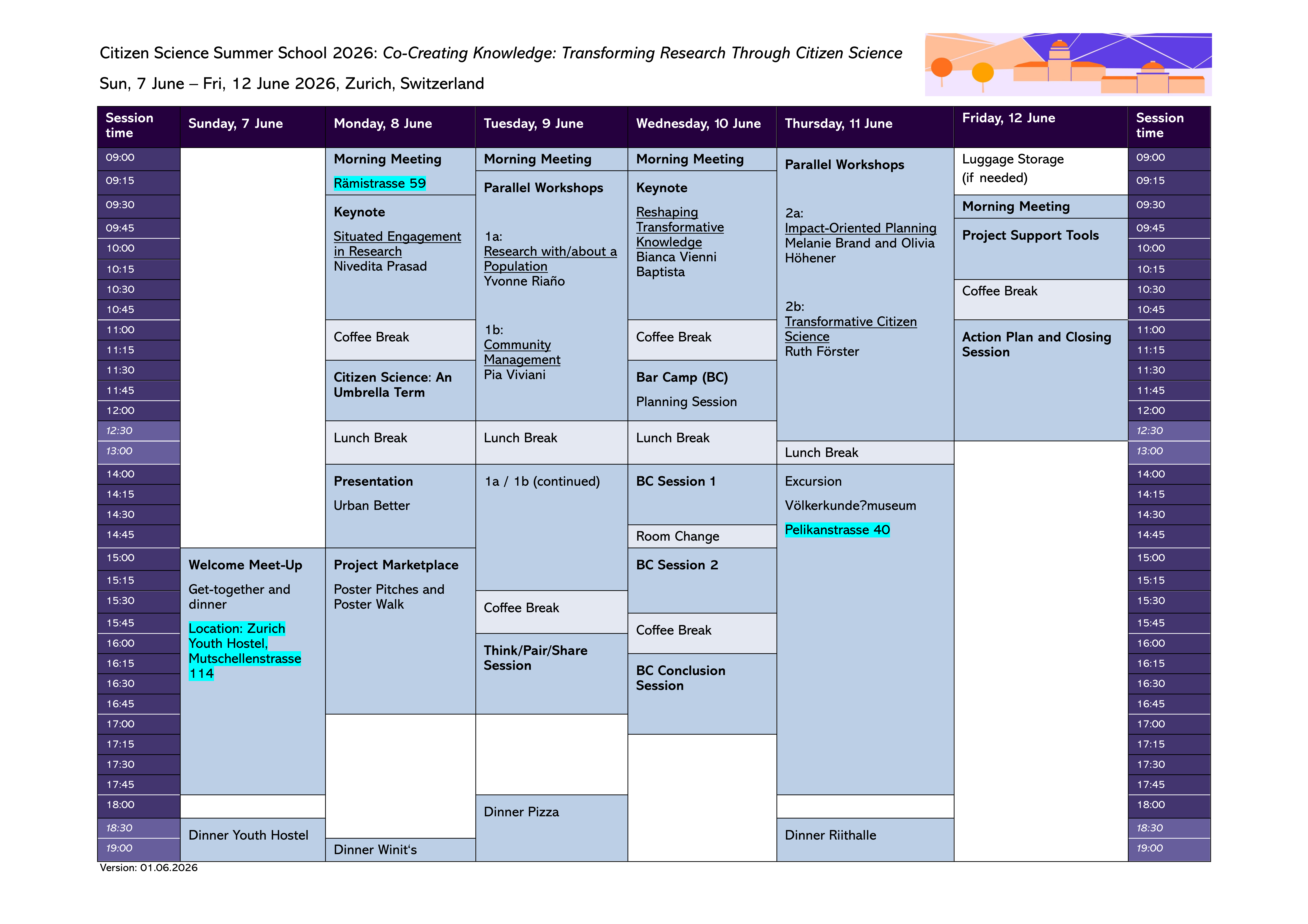
Preliminary Program

  Sunday Monday Tuesday Wednesday Thursday Friday
Morning


Keynote: Prof. Nivedita Prasad Parallel Workshops: Yvonne Riaño / Pia Viviani
 
Keynote TBA Parallel Workshops: Olivia Höhener & Melanie Brand/tbd Action plan and closing session
Afternoon Welcome Meet-up Science Fair Bar Camp Excursion on collaborative exhibition curation -Ethnographic Museum   
Evening Dinner Dinner Dinner   Dinner  


Speakers & Trainers

Keynotes:

  • Prof. Nivedita Prasad, is Professor of Action Methods and Gender-Specific Social Work at Alice Salomon University in Berlin, where she heads the MA programme in Social Work as a Human Rights Profession, among other roles. Her research methodology is strongly oriented towards (feminist) participatory action research – a research method that tends to be neglected in Western Europe.

Workshops: 

Parallel Workshop 1a: Working with or about a population group? Perspectives on Participatory Approaches using the Example of the Minga Methodology

by Prof. Yvonne Riaño, Associate Professor, Institute of Geography, University of Neuchâtel, and President of the Swiss Association of Geographers (ASG) 

This workshop explores how researchers position themselves in relation to the populations they study. We will begin by introducing approaches from from feminist and postcolonial theory that challenge traditional approaches to scientific knowledge production. These approaches question power relations that can exist between " research objects" and researchers when the latter have absolute control over the questions asked, the methods used, and over the interpretation and dissemination of the results. Feminist and postcolonial approaches call on us to "democratize" research practices in the social sciences.

In a second step, we will present the Minga methodology, developed in 2014 by Yvonne Riaño in the context of a research project with migrant women in Switzerland and further developed in the context of other research projects. This methodology attempts to meet the challenge of feminist and postcolonial approaches by proposing a participatory approach that aims, on the one hand, to generate "spaces of mutual learning" and, on the other hand, to produce social science knowledge in collaboration with "experts and professionals of daily life". Photovoice, among other participatory methods, will be introduced and explored as an example, with a short hands-on exercise allowing participants to experience and reflect on the method in practice. Issues of scientific validity, reflexivity, and positionality will be placed at the centre of this participatory research practice.

In a third step, participants will be encouraged to reflect on the following questions based on their own research projects:

How can we conduct socially responsible research that aims to collaborate with research partners, rather than engaging in an extractive practice? What participatory research methods are appropriate depending on the research context?
With which research partners and in which contexts should we collaborate? What inclusive spaces can we create to co-produce knowledge with our research partners?
How can participatory research contribute to better scientific understanding? How can it lead to social and personal change?
These reflections will be followed by group work, the results of which will be presented to the plenary of participants, followed by a general discussion on the limits and possibilities of participatory methods.

Parallel Workshop 1b: Community Management

by Pia Viviani, catta gmbh, founder and director

If you think you can set up and plan your Citizen Science project on your own, think again! To find people collaborating with you in a project, you need to know who they are before you start planning too many other project details. Who are the actors and organizations you need to make your project successful? What are their interests? How can you reach them? And how do you set up a project that takes different interests into account? If you can answer all these questions, there is a good chance you will find enough citizen scientists collaborating with you.
In this workshop, we are going to use an example of a Citizen Science project and work through a checklist you can later use for your own projects.

Learning objectives:

Participants know how to

  • set up a stakeholder analysis
  • identify your collaborator’s interests
  • catch potential collaborators' attention
  • offer different levels of participation
  • make people stay with you

Parallel Workshop 2a: Impact-Oriented Planning of Citizen Science Projects
by Olivia Höhener & Melanie Brand, Citizen Science Zürich 

Participatory Citizen Science is characterized by its intention to achieve not only scientific but also societal impact. This raises the questions: What is societal impact? How can the impact potential of Citizen Science be assessed? And how do I achieve impact with my Citizen Science project?

In this workshop, we will demonstrate impact-oriented planning steps using examples of Citizen Science projects. The participants will transfer the input step-by-step to their own projects. This provides participants with a logical project model, allowing them to plan, implement, and evaluate their projects effectively. 
In addition, we will introduce a range of different societal impacts. The participants will discover the impact potential of their project ideas and identify criteria and exemplary indicators for assessment.

Learning objectives:  

Participants

  • recognise the benefits of a logic model for project planning and implementation and are motivated to use it
  • can structure their project objectives and goals according to the levels of a logic model
  • understand the importance of precise target group differentiation and can implement it
  • broaden their knowledge of different societal impacts of citizen science, including the importance of the quality of participatory research processes
  • can identify criteria and exemplary indicators for assessing societal effects in their projects
  • can plausibly derive cause-effect relationships per target group and translate them into their logic model
  • can determine effective project activities based on their reflections on the cause-effect relationships

Excursion: 

Ethnographic museum of the University of Zürich: Explorting Citizen Science for Collaborative Exhibition Curation & Archiving 

As part of the Summer School, participants will visit the Ethnographic Museum to engage with Rumble in the Archive, a participatory and community-driven space that critically examines Zurich’s colonial entanglements and postcolonial present. Rather than functioning as a conventional exhibition, Rumble in the Archive is a collective space for archiving, learning, and encounter, created by artists, researchers, civil society actors, and the museum team. 

In addition, the visit will include an exchange on the museum’s ongoing renaming process. Participants will discuss how participatory citizen science approaches are being embedded in this institutional transformation, and explore different modalities of public involvement in reshaping archives, narratives, and the museum’s identity.